
How to build a website the pre-sells for a sales-led B2B SaaS product
What you can do to align your website with your buyer’s journey, where things often go wrong, and how to keep optimizing without months-long research projects
What if your website both answered pre-qualifying questions that your prospects research when they build their shortlists — and helped you build a strong case for choosing your product?
For sales-led B2B SaaS, the starting point is making sure that the website is actually with what their prospects are looking for — whether they’re relying on AI search or not.
Read on to learn how to recognize the signs that your website is misaligned with buyers’ needs — and how to get back on track to bring in more of your best-fit prospects.
Product features ship faster. Competitors’ solutions evolve just as rapidly.
For PLG B2B SaaS, those changes don’t change the overall goal — getting prospects to try out their product.
But what if your prospects need to be convinced that it’s worth getting on a demo before they can experience the product? For sales-led B2B SaaS with complex products, this is exactly the case.
In the past, the most common solution has been to try and build an evergreen website that would be updated every couple of years. Generic enough that new launches didn’t have to be incorporated into the copy, and specific enough to give some idea of the product differentiation.
But the main goal stayed the same — getting prospects on the demo so that they could experience the product and get to “aha!”
The work of selling started after the MQL handoff to the sales team.
With AI tools making it much easier to do prelim research without spending weeks on digging through forums and websites, B2B SaaS websites are up for a reckoning.
Now even time-strapped teams have quick access to data from review websites, forums, and competitor comparison posts and pages — which may or may not represent your product and its capabilities accurately.
The more high-level and generic your website is, the more difficult it’ll be for you to bridge that gap.
Pre-selling instead of MQL handoffs
B2B buyers were already frustrated with the lack of information required for creating a shortlist. Now that they can just ask AI tools to do the initial sweep for them, your product gets 1-2 sentences in the AI search results.
Which means that those 1-2 sentences need to do enough to get your prospects to find out more — and then decide that it’s actually worth their time to get on a demo.
Pre-demo considerations and concerns often are the last missing piece in the buyer journey. Which means that marketing teams don’t know how to influence prospects’ decision-making and put their best food forward. That, in turns, means that teams are stuck in endless cycles of second-guessing themselves and tinkering with headlines, button copy, and forms – while wondering:
“Are we presenting our products the right way?”
“Is our value prop clear?”
“Are we too close to our own messaging?”
(If you’re asking those questions after pushing your website live, that’s a red flag.)
In the absence of knowing what’s missing on the website from your buyer's perspective, website decisions are often based on assumptions about what a good website should look like. At the same time, building performing websites actually is hard, especially for scaleup teams that are constantly under pressure to execute faster.
So it makes sense that website planning gets compressed into “What are the best practices for our industry?” — even though their effectiveness is not a given.
In my work with sales-led B2B SaaS startups and scaleups, I’ve seen these 2 common approaches backfire:
Website as a branding play
Website as a PLG funnel
Website as a branding play
It feels like this approach is everywhere: “The future of…” / “Old way / new way” / “X, reimagined…” etc. are now much more common across hero sections than they used to be.
I think there are multiple reasons for it, from many SaaS getting rebuilt around AI to the perception that this is what the buyers are looking for and more practical considerations, like keeping the volume of website work manageable for smaller marketing teams.
Here’s what I believe: having a recognizable brand is going to become a competitive advantage in the world of SaaS sameness.
But branding plays — including copy — need to be tied to a meaningful differentiator that prospects actually care about.
Predictably, not knowing what customers care about, what they think makes your product unique, or why they stay with you means defaulting to less relevant farming options, creating variations of competitors’ messaging, or writing for made-up personas
Is this you?
How high are the bounce rates across your web pages? How deep is the scroll? How many pages on average do visitors touch before exiting?
If 60% of your homepage is an announcement about the most recent Gartner report – or an AI feature – how many people do actually read it? Or do they leave before even getting past your hero section?
Website as a demo funnel play
The funnel-focused approach is an adaptation of the PLG approach for sales-led GTM, assuming that the role of the website should be “bring in more demos.”
The funnel-based approach assumes that most prospects are willing to sign up for a demo as the next best step to evaluate a number of products and then build a shorter list for the next phase.
This is where it may be out of sync with buyers’ preferences and actual behaviors, for example:
Assuming that only one persona from the buyer committee matters (like C-Suite), even though they don’t initiate the search
Focusing on reducing the friction – keeping pages short and sweet, removing details that champions need to compile their shortlists
Overindexing on signal KPIs and gating case studies, interactive demos, or forcing contact with sales in other ways before prospects are ready
In industries where there are few available options or where early adopters actively want to hear about new solutions, this may not be an issue.
This is where pre-selling on your product to be added to the shortlist becomes more important:
Crowded markets where websites don’t offer enough context to make an educated decision about which products to consider
Audiences allergic to being sold at or skeptical about sales calls vs actual product performance
Complex deals where product implementation is likely to be a long and difficult process
Is this you?
Are you seeing diminished returns from gated assets?
Do you see high exit rates on your demo signup page?
Does your web conversions pipeline look healthy — or are there multiple dropoff points?
I’m not arguing that websites should be disconnected from branding – or that tracking conversion paths is a futile exercise. Of course not!
The common denominator for both of those approaches is ignoring the buyer journey and not including product information that prospects are actively looking for.
This means creating a vacuum that is going to be filled with other sources, from Reddit threads and G2 reviews to competitor posts.
Is this you?
Do you only have G2 reviews from 2 years ago?
Are you tracking what people say about you in online forums?
Are your competitors lining up competitor comparison articles and pages that don’t accurately represent your product or your differentiators? If yes, how are you planning to respond?
Making your website match prospects’ research goals and show up in search as an answer to their queries won’t be possible without actually knowing their mindset, requirements, or competitor set considerations — and incorporating that knowledge in your web page plans and content.
The challenge here is: it can be hard to know what “good” looks like. So even teams that start with the best intentions start modeling their web pages based on what they see online — and inevitably drift away from what their prospects need.
6 common types of misaligned B2B SaaS websites
In an ideal world, marketing teams don’t operate on guesswork, instead building:
a shared understanding of prospects’ pain points and motivations that informs content, demand gen, outreach and web copy
systems to constantly test assumptions and continue optimizing copy for better performance
feedback loops to discover market shifts that would otherwise go undetected earlier so that teams can react before those shifts affect the pipeline
Very often, web pages are instead built based on information from the sales team and/or guesstimating what prospects are looking for.
Here are the frequent guesstimate traps I see sales-led B2B SaaS scaleups fall into:
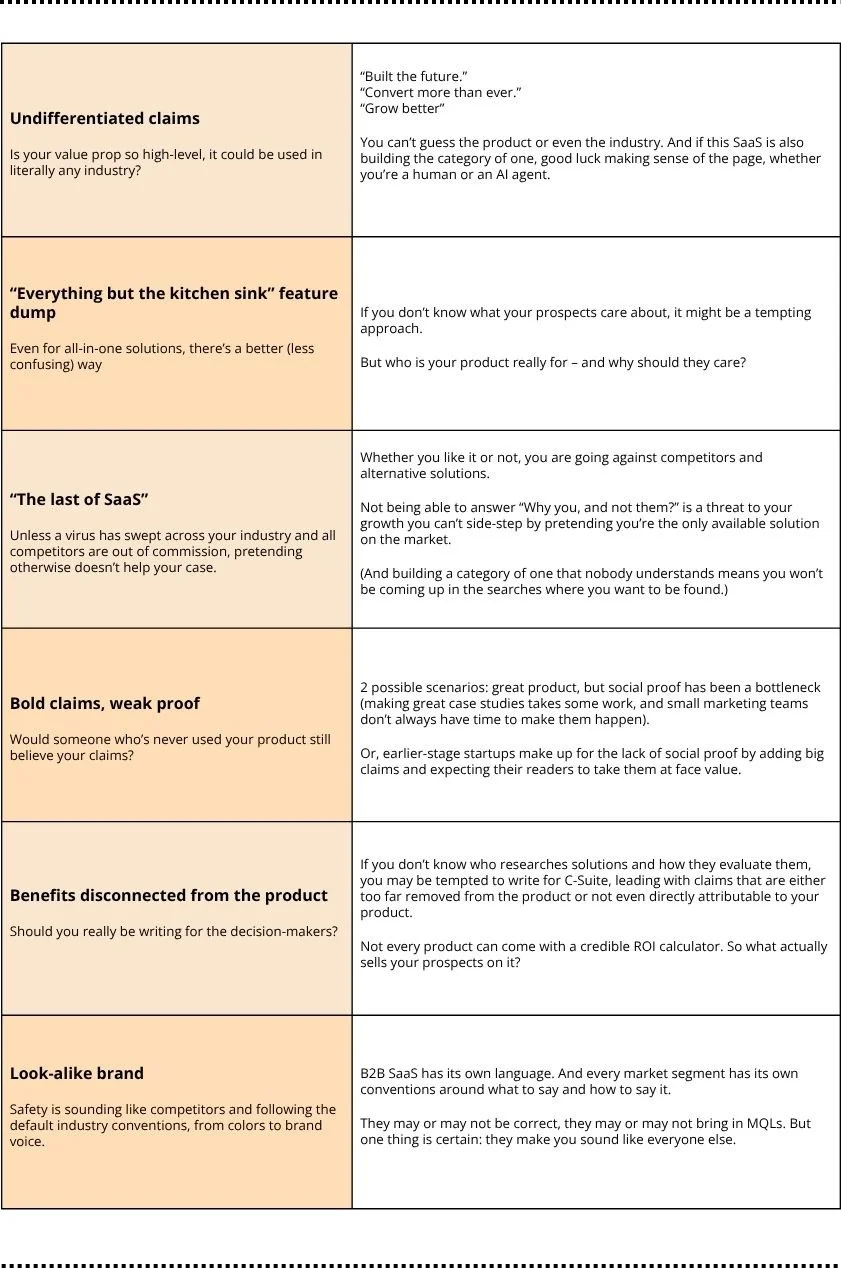
The worst part: the cost of misalignment is invisible — you can’t track events that don’t happen, so a lot of times, there’s no easy way to identify what exactly isn’t working.
So teams often default to tweaking on-page elements or doubling down on reducing friction in the homepage-to-demo-page funnel — which instead brings in unqualified prospects and creates more work for the sales team.
A website that pre-sells: 3 must-haves
That gap is impossible to fill without understanding prospects’ journey and drivers behind that journey.
That information also makes it easier to know what exactly isn’t working on your current website — because now you know what makes your customers value your product, what they like and dislike about your current brand, how they perceive you and what makes them choose you.
And that helps you build a website and a brand identity that are impossible to copy.
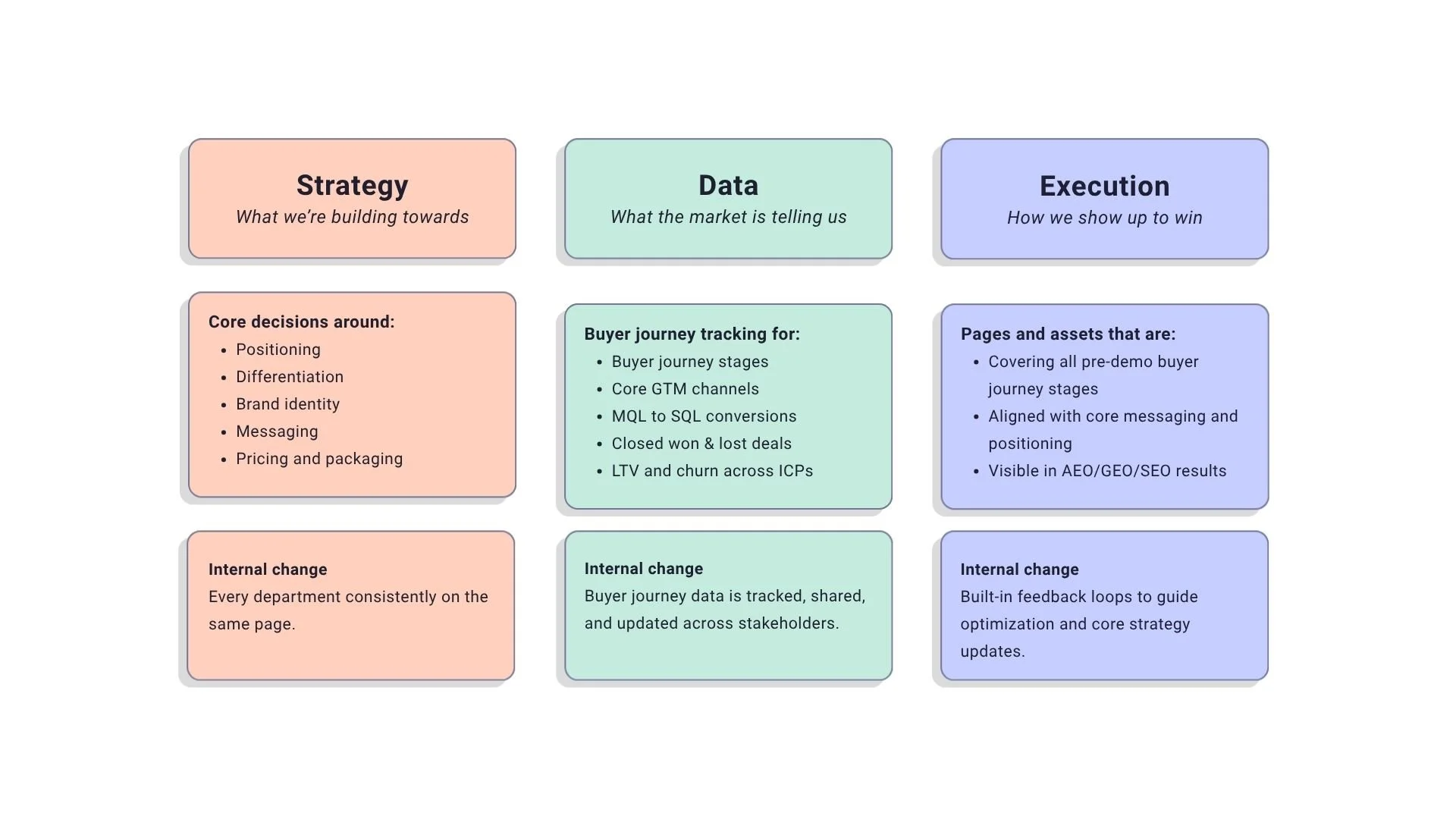
In my work with sales-led B2B SaaS scaleups, the most impressive results came from being able to build a strong product narrative and then translate it into web pages and content that work together, turning that core story into a strong signal that brings in best-fit customers.
1: buyer journey alignment
Most teams recognize the truth: there’s never going to be a point when you can stop researching. The challenge here is finding the sweet spot for the tradeoff — and busting through the common myths about customer research: that it’s time-consuming, painful, and easily replaced with best guesses.
Here’s my take: your sales team has at least 80% of data you need to start making better decisions about your website. The scaleups that are going to go the extra mile to get to the pre-sales data are the ones who’ll be able to build stronger positioning to attract their prospects and stand out.
Here are some signs that learning more about your buyers’ journey can help you get better results from your website:
Most of the prospects don’t “get” your product until the end of the sales call
You have an objectively better product, but your prospects treat it like interchangeable with competitors’ solutions
Your sales team needs to address common misconceptions or actively screen for wrong-fit prospects
Your sales team often spends time on addressing the same objections or responding to questions instead of building a personalized use case
2: meaningful brand differentiation
Should you be launching a mascot? Do you need a side line in plushies? Would a jingle increase brand recognition?
I wouldn’t know.
For the purposes of this conversation, distinctiveness is focused on:
Does your website provide specific, meaningful, differentiated reasons to book a demo for your product?
Does your website sound like every other B2B SaaS website out there?
Does your copy recycle the claims your competitors are making?
Not every brand needs a Liquid Death type of brand voice. Not every claim needs to be unique for the sake of being different.
The goal here is to be different enough — in a way that matters to your prospects.
This is another challenge that customer research can solve for you — it can tell you exactly what you can lean into, what would be a distraction, and how you can talk about your product without repeating cliches from every other B2B SaaS website.
And, best-case scenario, you’re also building a strong foundation for what your brand stands for.
3: systems to continue learning
The layer that many orgs don’t build until much later is the feedback loop layer. Instead of waiting for sales performance data to trickle back at the end of the quarter, you should be able to see how your website visitors interact with your website — and hear from them.
From scroll depth to exit intent surveys to built-in feedback collection in signup forms, all of those little touchpoints can give you ideas for how to keep building better pages. And that’s even before we get into impactful customer interviews with recently converted customers (or not converted prospects).
Here are some examples of mini-loops that can change your website for the better:
Finding and fixing critical issues, like low scroll depth combined with a high bounce rate on your homepage
Tracking prospects’ interest in specific features or use cases
Analyzing visitors’ questions in on-page chats
Identifying pages where prospects get confused and do a U-turn
And more…
See if your website could do more to pre-sell on your product
Wondering if your website might be out of alignment with your ideal customers’ buyer journey, too generic to help you stand out, or missing critical feedback loops?
Use this online assessment to figure out your next steps. After you get your results, you can also book a free 1:1 call with me to build an action plan for website optimization.

I help sales-led and sales-assisted B2B SaaS startups build websites that put them on their prospects' shortlist. If you suspect that you’re missing out on deals because your website doesn’t do enough pre-selling, reach out.