
B2B SaaS startups in 2026: what it’s going to take to grow (and is the answer “AI?”)
When anyone can just spin up anything, why pay money for a tool? And if anyone can AI-agent their GTM, how will startups win?
tl;dr
B2B SaaS startups will be able to win by combining a messaging foundation with AI tools that take over data wrangling, collecting data across silos, and building drafts for GTM.
The messaging foundation will consist of:
Defensible differentiation that’s consistently repeated across web pages and cross-channel messaging
Messaging grounded in voice of customer, not workshopped soundbites
Brand voice that’ makes your copy and content recognizable and enjoyable
Earned credibility that’s based on understanding your ICP’s world (and results you’ve been able to get for your customers)
Clarity on customer journey triggers and segments that are the best match for your product
AI double bind: replacing people & products
Not every industry is adopting AI tools at the same rate. Not every company is implementing AI agents or is giving its employees free reign to experiment with AI.
Even so, it’s easier than ever to build something in-house to solve a specific problem.
So startups need to prove that they’re not a feature in a wrapper, but an investment worth making — because it works better that homegrown solutions.
The way startups operate is also changing:
barriers to entry are so low as to be practically nonexistent, making differentiation and segmentation more important
in-house teams can get more done, without having to hire contractors – and move faster
finally, AI tools can help make sense of large volumes of data
It also means that it’s easier than ever to launch campaigns that move in the wrong direction, if you don’t know what makes your prospects buy:
spin out vague-sounding messaging that sounds like everyone else
fill up pages and pages with content that’s not even remotely aligned with prospects’ JTBD
build campaigns based on high-level talking points like “this thew segment cares about ease of use” (who doesn’t?)
Old problems — disguised as new opportunities
Before we had “just use AI,” we had “just use this wireframe,” “steal my hook,” and “lead with benefits.”
Except without customer research they all result in generic copy based on assumptions and best practices, instead of focusing on what matters to the target audience and resonates with them.
And copy is just a tip of the iceberg.
For many of the startups I’ve worked with, the real challenge was uncovering what really motivates their prospects to act and what makes them pick that specific solution – not making headlines snappier or copy shorter because “nobody reads anymore.”
Solving for variations in tone of voice, headline phrasing, or moving around words on the page without questioning the underlying assumptions or taking the time to replace those assumptions with customer data won’t help you get traction.
Because you’re still running on the Random Acts of Marketing™ OS, instead of doing foundational work:
Long sales cycles with lots of back-and-forth
Wrong-fit prospects wasting your sales team’s time
MQLs barely trickling in because traffic landing on the website doesn’t convert
Agony over tactics (“Are we doing the right thing?”)
Lack of confidence (“Should we keep doing the thing and tweak it… or do we need to do something different?”)
An example of skipping foundational work would be acting on “if we make our cold outreach copy / website copy / LinkedIn posts more conversational / funny / memorable, we’ll get more traction.”
What is this hypothesis based on? Does your audience want “funny”?
Have you clearly defined your audience?
Is your current email / website / post aligned with their stage of awareness and their goals for that stage of awareness?
Or are you missing out on chances to make your messaging more impactful?
The “make it more {something}” part is the last part that gets layered on top of everything else.
So startups trying to grow will need to go beyond the baseline ad-lib approach to positioning and messaging and develop:
Defensible differentiation that’s consistently repeated across web pages and cross-channel messaging
Messaging grounded in voice of customer, not workshopped soundbites
Recognizable and enjoyable (for your audience) brand voice
Earned credibility that’s tied to your ICP’s goals and understanding of the industry
Clarity on customer journey triggers and segments that are the best match for your product
All of that comes down to running customer research, analyzing the results, and turning them into clear guidelines, copy, and tests.
Not new — but increasingly more important.
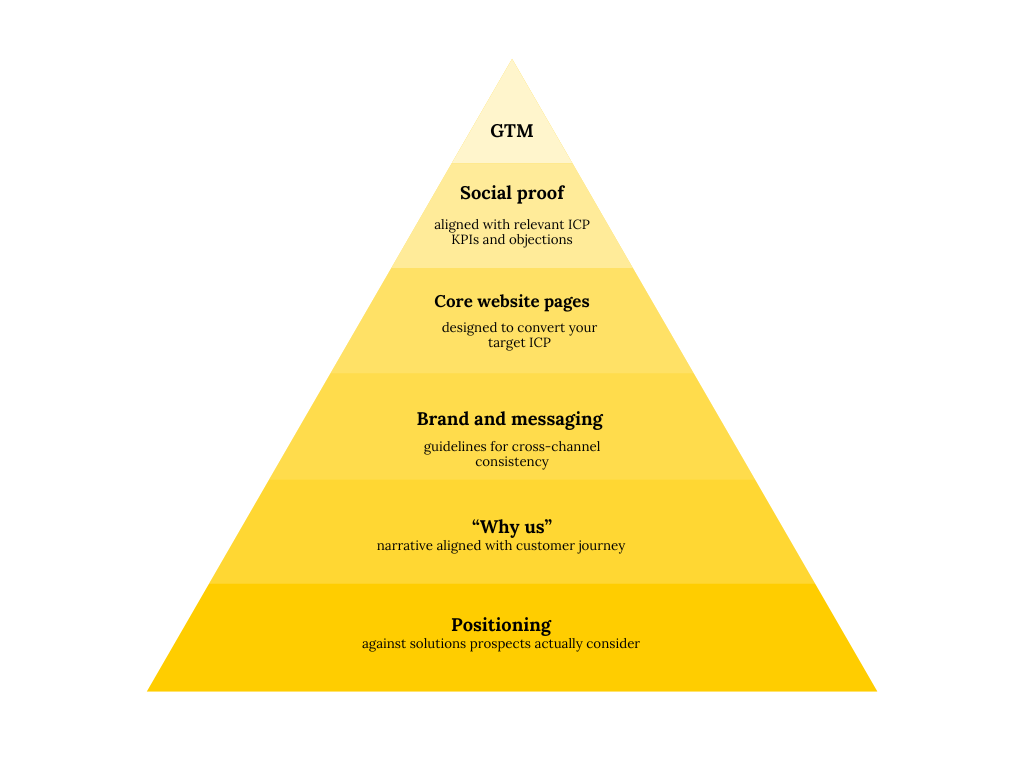
Maslow’s pyramid, but getting from positioning to GTM
“Based on customer data” doesn’t mean “paralyzed for months”
One of the most frequent assumptions that keep teams back from understanding their customers is the belief that it’ll take forever to get anywhere. And when the startup world keeps moving faster and faster, it feels risky to drop everything for 3 months and go into research mode.
Fortunately, it’s an unnecessary risk.
Especially now that there are so many tools for continuous discovery, customer research doesn’t have to be a massive undertaking that delays every initiative.
Instead, it can be broken into “what’s the next right thing?” pieces that fuel small (or large) changes your copy or messaging. Not to mention that in my experience, startup teams have a lot of answers – they just don’t know how to piece those pieces together, or are too stuck in the execution mode to snap out of it for a re–evaluation.
And, ironically, the cost of inaction is the same as the cost of doing the research: coasting in the default mode or watching your market share decrease because competitors are better at getting in front of your audience.
Except is you’re not doing the research, you' still won’t know how to fix this.
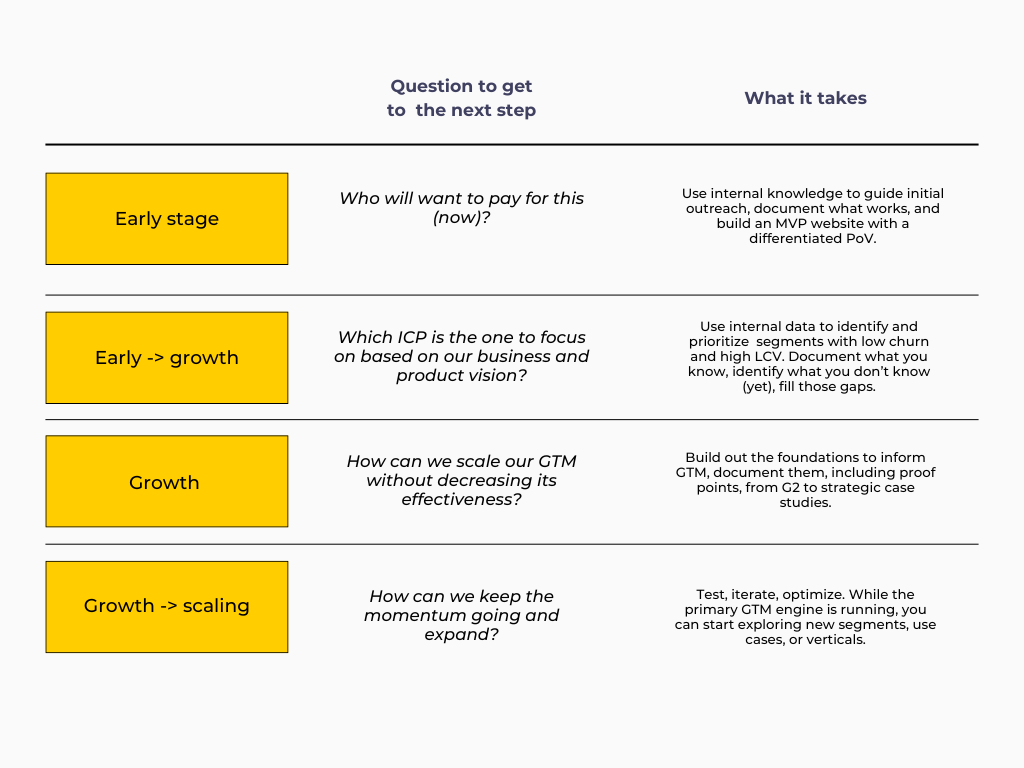
You don’t need all the answers. But the “What’s the next right thing?” questions can help you get unstuck.
Do you just need better words… or better foundations?
Execution (like talking about your product in company shorthand that makes sense internally, but confuses people outside of your startup) can be the root of the problem.
But far more often in my projects I see cracks in the messaging foundations.
Which means that there’s no internal alignment on or shared understanding of: positioning, messaging, differentiators, tone of voice, customer journey, objections / hesitations / motivations / pain points / JTBD, ICPs’ buying process, and types of proof they want to see and find persuasive.
That, in turn, leads to things falling apart when teams (or contractors) start executing:
no messaging or brand voice consistency across channels
defaulting to the same high-level statements ({10x your {something},” anyone?)
time wasted on tinkering with headlines when it’s the underlying message that doesn’t work
undifferentiated content based on competitors’ posts and a list of high-traffic SEO keywords (that don’t even match what prospects are looking for)
sales team defaulting to feature walk-throughs because there’s no company PoV they can rely on
cookie-cutter case studies focused on high-level outcomes and not addressing any of prospects’ concerns (like change management, pace of adoption, and time to value)
short, bland, forgettable website pages that don’t help prospects understand why they should try your product (especially if they can choose the default, risk-free established solution)
Once you have your messaging foundations in place (differentiation, messaging guide, brand voice guidelines and customer journey), the next step is making sure that nothing gets lost and/or misinterpreted in translation during execution across teams.
The easiest way to avoid execution-level misalignment is to have clear examples of what copy and messaging should look like in real-world conditions. Specifically, in the form of core website pages (tested and validated), serving as the jumping-off point for other types of collateral.
Finally, spinning wheels no longer — where AI fits in
If you’re just asking ChatGPT to spin up a buyer persona (which apparently is a thing?), you and everyone else will be working off of the same blueprint. And – quite likely – getting to the same answers.
But!
AI can free up time to do the things that we all (hopefully) know we need to do – but never get to, or only get to do once it’s clear that messaging isn’t working, new competitors are gaining ground, and we have no idea how to fix this. What if:
nobody had to spend hours digging through HubSpot notes or search for customer insights in Gong call transcripts?
you could just have all of that info pulled in and easily sorted, without creating insane tagging systems and hard-to-keep-updated spreadsheets?
your team could easily see what’s moving the needle, flag market changes earlier, and proactively test messaging, instead of only changing it when it stops working?
you had a readily available resource of voice-of-customer data to refer to whenever you need to build a new asset — or didn’t have to guess which customers to reach out to for case studies?
In other words, sense-making still needs to be done by humans — data-wrangling, on the other hand, can be taken over by AI.
Build, buy, ignore?
There are all kinds of hot takes on using AI for copy, from posts claiming you’ll never have to write a single headline or paragraph ever again to lists of tells for AI-generated content.
My concern is that both are oversimplification.
I’ve seen posts claiming that you can improve your messaging by automating review mining, in 2 prompts or less. If the starting point is a 1-hour messaging workshop, I’ll buy it.
But that shouldn’t be the starting point in the first place!
Review mining is awesome, but for messaging that’s not just “Well, it’s better than what we’ve workshopped,” you’ll also need to make sure that you’re:
Framing your solution against competitors
Matching your messaging to the most likely stage of awareness for your reader
Including credible claims, and
Sound like your brand, not every B2B SaaS startup out there
Here’s what I’m curious about:
Which parts of the customer research > messaging > copy process shouldn’t be handed over to AI (because they create blind spots)?
When does it make sense to use AI tools to make the process more efficient, without settling for generic outcomes?
And how to choose between building your own thing and relying on a ready-to-go AI-powered product — and when it’s a waste of time?
Most importantly, how to separate the hype from tips worth following and developing a better understanding of when AI is an ally and when it’s a shiny object that distracts from making a real difference.
Stay tuned for Season 3 of You’re Doing Growth Wrong. Sign up to get new episodes and occasional thoughts on how to get more conversions through your foundational web pages (and customer research).

I help post-PMF startups attract and convert more of their ICPs by building core website pages that positions them as the obvious solution for their target audience.
Find out more about building your highly-converting website pages in 8 weeks.

![[S2E6] How to build a content ecosystem to convert and support users](https://images.squarespace-cdn.com/content/v1/510fa084e4b060f86e73735a/1750284561646-AA8WDFHRFZ32GQO5GI51/S2E6+Podcast+Cover+visuals.png)
![[S2E5] Practical Guide to Wynter Messaging Tests](https://images.squarespace-cdn.com/content/v1/510fa084e4b060f86e73735a/1747226672649-1AU6KQD4RIGSNSIIQLGW/Solo_episode_cover.png)
![[S2E4] How to: message testing on a budget](https://images.squarespace-cdn.com/content/v1/510fa084e4b060f86e73735a/1744221834434-TF0URFQBJNYQPPMKQNHK/alex_atkins_cover_image.png)
![[S2E3] How to: positioning](https://images.squarespace-cdn.com/content/v1/510fa084e4b060f86e73735a/1742493000706-NG82ZT4YFEM2AFCDG03N/S2E3_Josh+Garofalo_COver+Image.png)
![[S2E2] How to find winning angles for your competitor pages](https://images.squarespace-cdn.com/content/v1/510fa084e4b060f86e73735a/1740671619617-YYWZU1UAQOHY3RDFNTIC/YDGW_S2E2.png)
![[S2E1] How to make research (like JTBD) a part of your company’s business processes with Eric White, ponder*](https://images.squarespace-cdn.com/content/v1/510fa084e4b060f86e73735a/1739463855416-52VCO2K3A62DVPIX2OWX/Eric_White_Cover_Image.png)