
(because your messaging, copy, and proof are so distinct they can’t be copied over)
Everyone in B2V SaaS seems to be rewriting their homepages.
And somehow, we end up with basically the same homepage with some line edits thrown in:
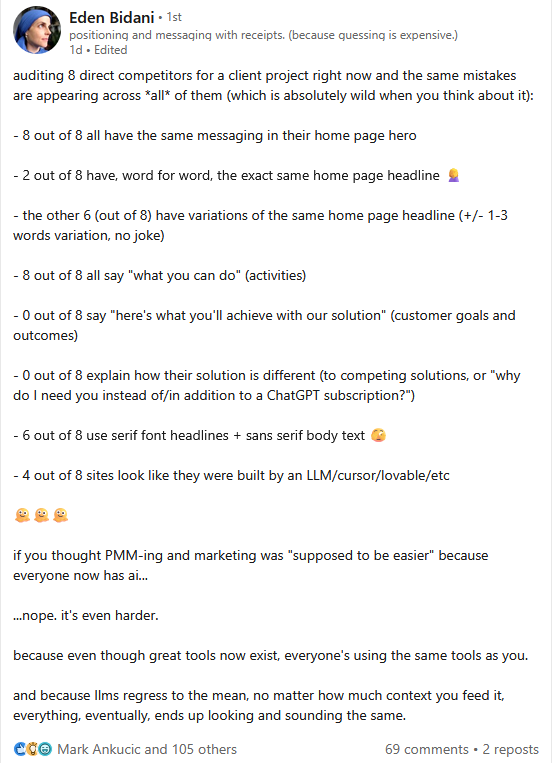
I don’t think it’s solely an execution problem. Or simply a using AI problem. (But relying on AI output’s probably not helping).
And, to be fair, it probably doesn’t matter what exactly got us to this point.
What’s more important is figuring out how to stand out in a way that’s actually relevant to your buyers and leads them to select your product.
Is this really a problem?
For B2B SaaS — yes. For your product specifically? Probably.
You can easily check by opening your primary competitors’ websites to see how similar they are to yours and/or tracking how many prospects you lose to them.
Even if not all of those changes are a complete positioning and messaging overhaul, it’s still a lot of changes to track and react to — and the risk I see is overreacting to competitors and overindexing on shiny objects (“agents and people working together” seems to be everywhere at the time of writing).
And, once you get into that hamster wheel, it’ll be much harder to produce un-flattened copy.
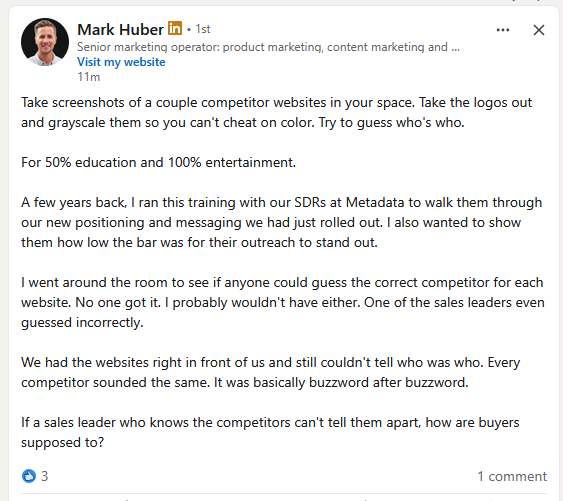
You can also try this fun experiment from Mark Huber:
What to do instead: meaningful differentiation (that customers care about)
So how to avoid the slippery slope?
In my opinion, the answer hasn’t changed — it’s making sure that your positioning, messaging, and copy decisions are guided by your understanding of your best-fit prospects and customers.
On the web copy level it means:
Answering “Why us”
Writing to match your best buyers’ journey, not force them through the shortest possible funnel
Optimizing not just your homepage, but also your sub-pages
Testimonials and case studies that are aligned with your differentiation and messaging, and
Distinctive brand voice and design
Only one of them is related to your brand voice. And one might argue it’s the least important one.
It also doesn’t protect you from market changes — especially if “build in-house” suddenly becomes a more attractive option. But it makes it easier to adapt to them without drifting towards generic headlines and vague feature descriptions.
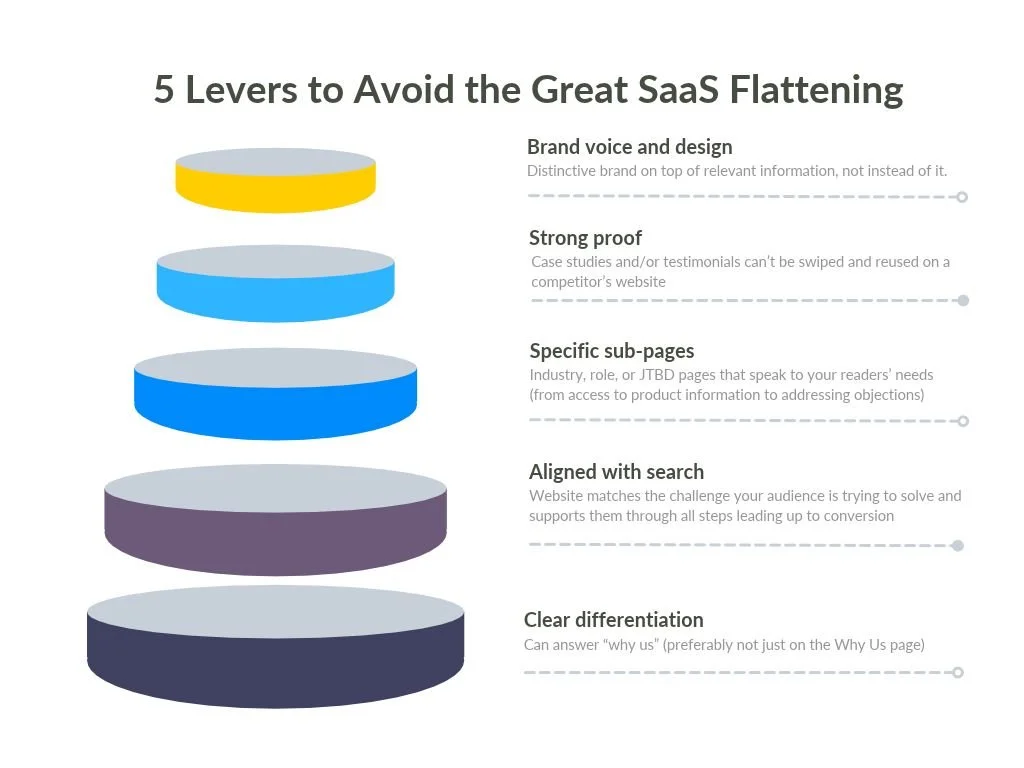
Brand voice is important, but probably not the most impactful lever until you have everything else in place.
[1] Being clear on what makes your product different
Many B2B SaaS startups default to not talking about competitors at all (you don’t have to name them to call out common struggles). Your buyers are likely aware of them anyway.
So, why you — according to your customers? Why did they choose your product, instead of all other options out there?
When unpacked, “Why us” hides multiple relevant data points around purchasing decisions, including:
what made the problem worth solving in the first place
how exactly your customers went about researching other solutions
reasons they chose your product.
Why it helps you stand out: you should be able to find a differentiator — or a combination of differentiators — that are much harder to copy than a generic homepage headline.
And one you find the differentiators that help solve frustrations your customers had to deal with and avoid the pain of using a less-than-ideal solution, that helps you leave vague copy behind and bring in specific, voice-of-customer-inspired copy.
Where to start looking for ideas: customer interviews, sales calls and case study interview recordings.
[2] Writing for people that are looking for a solution
This doesn’t have to be your homepage in every case (for example, Notion is being very smart about “Notion for…” sub-pages) and depends on how your prospects find you and on what it takes to get them from a website visit to a demo signup.
But if most of your recent deals closed because of a champion with a specific challenge they’ve been trying to resolve, it’s probably worth focusing on them instead of writing an AI vanity headline.
And if most of your recent deals closed because of a C-Suite-level decision, that would make for a very different argument.
Either way, your copy will be focused on the messages they need to see, in the order that makes sense for them.
Why it helps you stand out: actually helpful pages on your website! Tailored to what they’re actively looking for, helping them make a decision (in favor of your product) — what’s not to like?
Where to start looking for ideas: thank-you page surveys, customer interviews.
[3] Building out sub-pages that get specific
Even though a lot of SaaS lavish attention on their homepages, I’d argue that once you target multiple verticals or departments within organizations, your homepage needs to move them towards sub-pages that speak specifically to their needs.
In many cases, those pages are an afterthought and it shows.
Especially if you have more experience than competitors, this is the place to build credibility.
Why it helps you stand out: pages that prove to your industry-specific buyers you understand their needs and challenges and can help them accomplish their tasks better than other available solutions (as well as doing nothing and/or building in-house).
Where to start looking for ideas: sales conversations by industry, including frequently asked questions and requirements, customer interviews for recently closed-won deals.
[4] Building strong proof
Nobody can copy your testimonials or case studies, especially if they include customer quotes, video clips, and relatable challenges (by role or by industry).
Same goes for reviews that don’t look like they’ve been copy-pasted out of an outreach email or video quotes.
Why it helps you stand out: competitors may swipe your headlines (or arrive at a similar messaging approach without outright copying it), but copying great reviews or case studies would be much harder — especially if you have stories about switching from their solution.
Where to start looking for ideas: sales team interviews — what already works? What kind of proof do they wish they had access to? Where do your existing case studies fall short, if at all?
[5] Having a distinctive brand voice and visual identity
Probably the first thing that comes to mind when considering standing out. Dead last if you want to stand out in a meaningful way.
(That said, adding flashes of personality to copy — or, for bold brands, playing with headlines and design, is a lot of fun. I just don’t believe that it deserve to come ahead of a great product and customer-focused copy and messaging.)
Why it helps you stand out: different = memorable. Preferably in a good way.
Where to start looking for ideas: competitors’ websites — what’s already so overdone, it’s boring? Which (unexpected) direction would make sense for your brand?
Starting point: how different do you appear to be, really?
Not all of those levers may be applicable in your situation (especially if you already have impressive and distinctive case studies), so to figure out where to start — and whether you need to be looking into differentiation levers at all — it’s worth looking at what your competitors are saying on their websites.
And how different you actually sound from them, from your prospects’ point of view:
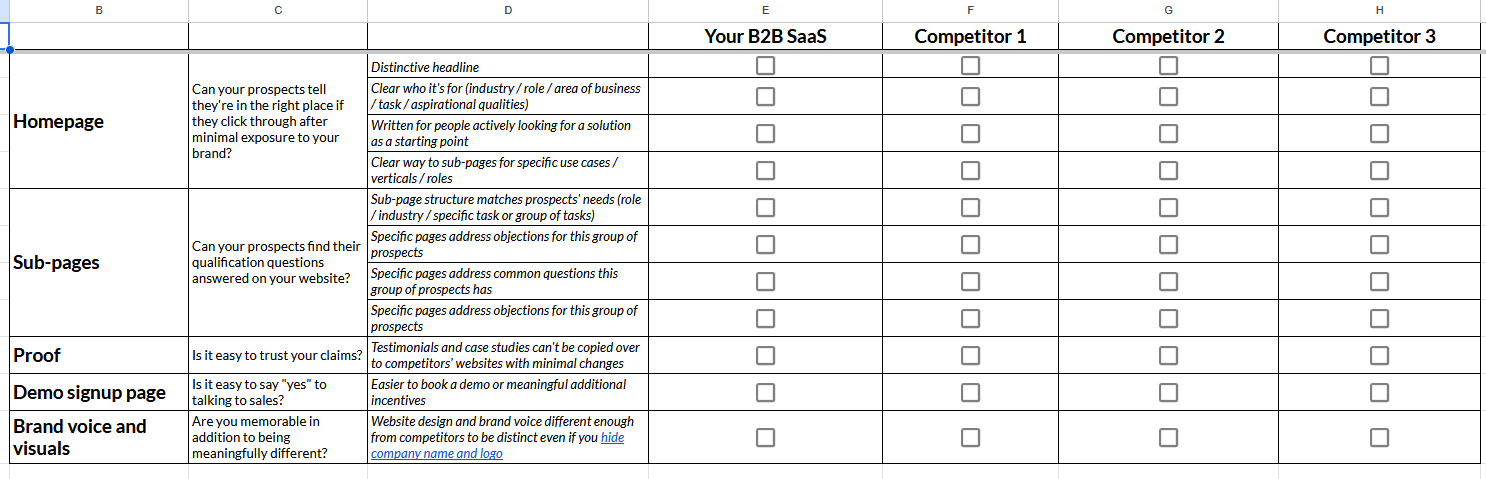
Grab the template here:

I help sales-led B2B SaaS startups with complex products optimize their websites to convert more of their best-fit prospects into demos.